The Legend of Camille Monfort Fact, Fiction & the Amazonian Vampyre
The Enigmatic Rise of Camille Monfort
Every few years, the internet conjures a new mystery—a ghostly figure from history who seems too strange, too cinematic to be real. In recent times, one such name has mesmerized folklore enthusiasts, paranormal bloggers, and TikTok storytellers alike: Camille Monfort. Described as a 19th-century French opera singer who met a tragic, vampiric fate in the depths of the Amazon, Camille’s tale blends romance, horror, and colonial mystique into a cocktail of myth that feels both old and eerily modern.
But who exactly was Camille Monfort? Was she truly a celebrated soprano whose mysterious death sparked the legend of the “Amazonian Vampyre”? Or is she a clever fabrication—an AI-assisted myth that proves how easily digital storytelling can blur the lines between truth and fiction?
The Opera Singer Who Vanished
According to the story spreading across social media, Camille Monfort was born in Paris in 1869. By her early twenties, she had already earned fame as a soprano in the French opera scene, enchanting audiences with a haunting, otherworldly voice. She was said to possess beauty of a kind that photographs could barely capture—pale skin, dark hair, and eyes so cold they seemed to pierce through the soul.
Legend continues that after suffering a public scandal and the death of her lover, Camille disappeared from Paris in 1890. Years later, she allegedly resurfaced thousands of miles away, performing for colonial audiences in Belém, Brazil—a city on the edge of the Amazon rainforest. Locals whispered that she performed only at night, and that her health never seemed to fade despite the tropical heat.
When Camille Monfort died mysteriously in 1896, her body reportedly showed no signs of decay. She was buried in Cemitério da Soledade, but visitors claimed to see her wandering the cemetery grounds long after. Thus was born the enduring epithet—the Amazonian Vampyre.
The “Rediscovery” of Camille Monfort
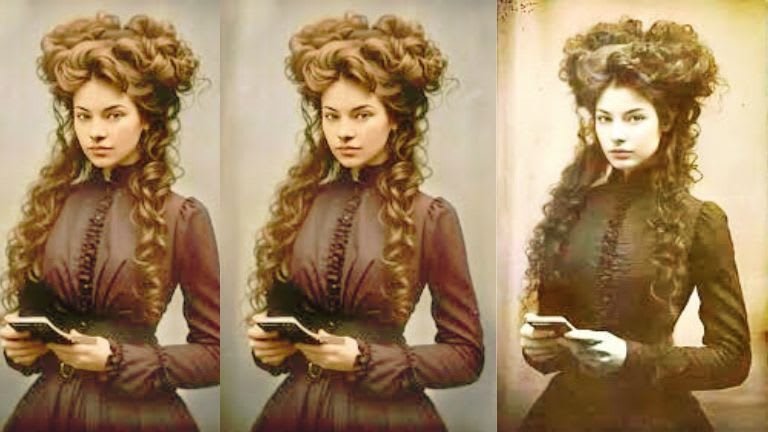
The myth remained obscure for over a century until the age of digital storytelling resurrected it. Around 2022–2023, eerie black-and-white portraits of Camille Monfort began circulating online. The images showed a somber Victorian woman in a high-collared gown, her gaze fixed with unnerving intensity. Captions claimed she was the “Parisian soprano who vanished in the Amazon,” sparking viral curiosity.
TikTok creators crafted short horror reels about her. Pinterest boards filled with her supposed “photographs.” Even amateur historians began debating her existence on Reddit and YouTube. The character of Camille Monfort had achieved immortality—not through blood or legend, but through algorithms.
What few realized at first, however, was that the name Camille Monfort didn’t come from an archival record at all. Instead, she appears in “Após a Chuva da Tarde” (After the Afternoon Rain), a novel by Bosco Chancen, a Brazilian author known for blending magical realism and historical fiction.
In other words, the opera singer may have been born not in 19th-century Paris, but in the pages of a modern novel.
Debunking the Myth: Fact vs. Fiction
As researchers and skeptical readers began tracing the legend’s origins, inconsistencies piled up. There were no opera programs, newspapers, or concert archives from the 1800s that mentioned any “Camille Monfort.” Likewise, records from Belém in the 1890s list no such performer.
Even more telling, the haunting portrait of Camille that sparked the viral fascination is now widely recognized as AI-generated art—a photorealistic blend of vintage aesthetics and digital design. Some versions even showed small anomalies common in AI renderings: mismatched buttons, distorted jewelry, or faint artifacts around the eyes.
It soon became clear that Camille Monfort’s tragic tale was a modern invention—a digital ghost built from fragments of literature, aesthetic nostalgia, and the collective imagination of the internet.
Why We Want to Believe in Camille Monfort
Despite evidence debunking her existence, the legend of Camille Monfort continues to thrive. Why? Because her story satisfies something deep in our collective psyche.
Camille embodies themes that never go out of fashion: forbidden love, artistic obsession, immortality, and the exotic mystery of far-off lands. Her story feels timeless, as if it could have been a lost chapter from gothic literature—part Dracula, part Phantom of the Opera, and part Madame Butterfly.
Moreover, Camille’s myth highlights how our digital world revives the folklore impulse. Just as oral tales once spread across villages, TikTok videos and AI images now carry modern myths from one feed to another. We may know these stories aren’t real, yet we share them anyway—because they let us feel part of something mysterious, poetic, and darkly romantic.
Camille Monfort and the Power of Digital Mythmaking
The story of Camille Monfort isn’t just about a fictional singer—it’s about how stories evolve in the 21st century. In a world where AI can fabricate “historical photos” and social media amplifies them to millions overnight, fiction no longer needs a publisher or museum archive to feel authentic.
Camille’s rise demonstrates how AI-assisted folklore can take on a life of its own. A character written for a book becomes a visual meme. A meme becomes a haunting mystery. A mystery becomes a “fact” repeated across hundreds of blogs and videos. Within months, a complete mythology is born—crowdsourced by curiosity and belief.
It’s a fascinating reminder that the tools we use for creativity can also shape our understanding of truth. The Camille Monfort phenomenon shows both the magic and the danger of storytelling in the digital age.
The Enduring Allure of the Amazonian Vampyre
Even knowing she never existed, Camille Monfort continues to haunt the imagination. Artists have painted her, musicians have composed songs inspired by her supposed arias, and writers have adapted her legend into short stories and graphic novels.
Her name now carries a symbolic weight—standing for every forgotten woman, every silenced artist, every tragic muse who might have been lost to history. She may not have walked the streets of Paris or sung beneath the Amazon moon, but Camille Monfort has achieved something more enduring: mythical immortality.
Conclusion: The Ghost in the Feed
In the end, Camille Monfort is not a vampire in the literal sense. She doesn’t drink blood—she feeds on fascination. Each share, each retelling, each AI portrait gives her new life. She’s the perfect creation for an era obsessed with nostalgia and mystery: a ghost of pixels and prose, haunting the modern imagination.
And while her grave may not exist, her legend certainly does. As long as people crave stories that blend beauty with darkness, truth with fantasy, the Amazonian Vampyre will continue to sing.
At shoujoramune, we celebrate such stories—not for their factual accuracy, but for the way they reveal our endless hunger for meaning in a world of digital myths.