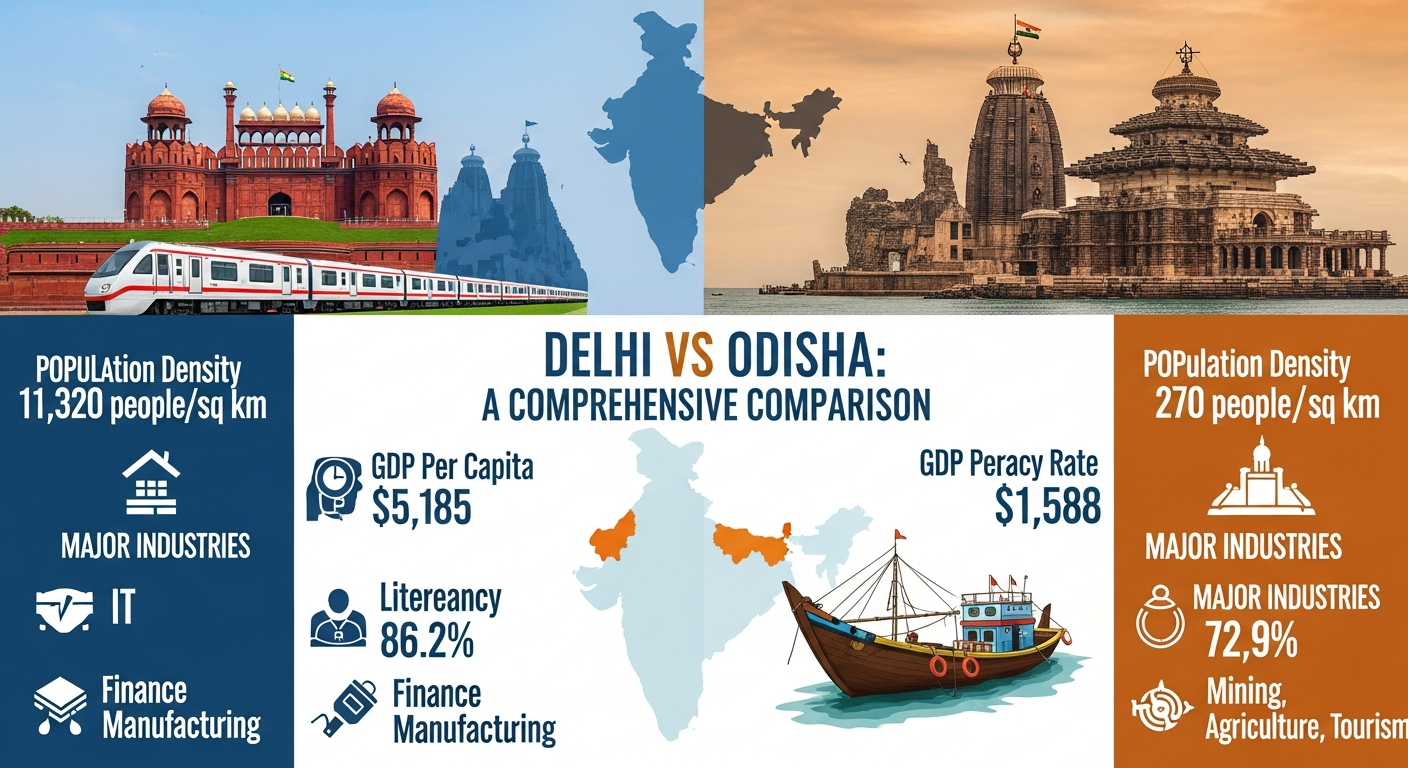
Delhi vs Odisha: A Comprehensive Comparison
When it comes to understanding India’s diverse states and regions, comparing Delhi and Odisha provides an intriguing study. Both places have unique characteristics, histories, cultures, and development trajectories. While Delhi serves as the political and administrative capital of India, Odisha is an eastern state with a rich cultural heritage and abundant natural resources. This article explores the differences and similarities between Delhi vs Odisha in terms of geography, economy, culture, education, infrastructure, tourism, and lifestyle.
Geography and Climate
Delhi is located in northern India and acts as the country’s capital territory. It is bordered by Haryana and Uttar Pradesh and lies on the banks of the Yamuna River. The city experiences an extreme climate with hot summers, cool winters, and a monsoon season. Summers can reach up to 45°C, while winters may drop to around 5°C. Its flat terrain and urban sprawl make it a highly populated metropolitan area with limited green spaces in comparison to its population.
Odisha, on the other hand, is situated on the eastern coast of India along the Bay of Bengal. It is characterized by a diverse landscape, including coastal plains, hills, rivers, and dense forests. Odisha’s climate is tropical, with hot and humid summers, mild winters, and heavy monsoons. Cyclones are also common in this region due to its proximity to the Bay of Bengal. Compared to Delhi, Odisha has a larger proportion of natural landscapes and forested areas, contributing to its ecological significance.
Historical and Cultural Significance
Delhi has a rich historical and political legacy. As the capital of several empires, including the Mughals and the British Raj, it boasts numerous historical monuments such as the Red Fort, Qutub Minar, Humayun’s Tomb, and India Gate. Delhi is also a melting pot of cultures, with people from all over India residing in the city. Festivals such as Diwali, Eid, Christmas, and Holi are celebrated with grandeur, reflecting the city’s cosmopolitan culture.
Odisha is known for its deep cultural roots, particularly in art, dance, and architecture. The state is home to the famous Jagannath Temple in Puri and the Sun Temple in Konark, which are significant landmarks of religious and architectural importance. Odissi, the classical dance form originating from Odisha, is renowned worldwide. The state celebrates unique festivals such as Rath Yatra, Durga Puja, and Raja Parba, which showcase its traditional lifestyle and cultural richness.
Economy and Employment
Delhi is one of India’s major economic hubs, contributing significantly to the country’s GDP. It has a diversified economy, including services, IT, telecommunications, tourism, manufacturing, and retail. Delhi is home to many multinational companies, startups, and government offices, making it a center for job opportunities in various sectors. The city attracts professionals from across India due to its employment prospects and infrastructure.
Odisha’s economy is primarily driven by agriculture, mining, and industrial sectors. The state has vast mineral resources, including coal, bauxite, and iron ore, which support its industrial growth. Odisha also focuses on developing power generation, steel, and aluminum industries. Agriculture plays a crucial role, with rice being the main crop. While Odisha is growing economically, employment opportunities in urban areas are relatively fewer compared to Delhi, prompting migration of youth to metropolitan cities for better prospects.
Education and Literacy
Delhi boasts a high literacy rate and a strong educational infrastructure. It is home to prestigious institutions such as the University of Delhi, Jawaharlal Nehru University, and Indian Institute of Technology Delhi. The city offers quality education from primary to higher education and has numerous private and international schools, colleges, and research centers. Delhi’s literacy rate is above the national average, making it a hub for academic excellence.
Odisha has made significant progress in improving literacy and educational facilities over the years. The state has several universities, including Utkal University and Odisha University of Technology and Research. Government initiatives have improved access to education in rural areas, yet challenges such as dropout rates and quality of education remain. Odisha’s literacy rate is improving steadily but still lags behind metropolitan areas like Delhi.
Infrastructure and Urban Development
Delhi is a metropolitan city with advanced infrastructure, including metro rail, expressways, airports, and modern residential and commercial complexes. The Delhi Metro is one of the most efficient public transportation systems in India, connecting the city with neighboring regions. However, the city struggles with traffic congestion, air pollution, and limited green spaces due to rapid urbanization.
Odisha, while progressing in urban development, still has comparatively less developed infrastructure. Bhubaneswar, the state capital, is known for its planned city layout and IT corridor, while Cuttack and Rourkela have industrial and commercial significance. Public transportation is improving, and road networks are expanding, but rural connectivity and urban amenities are still developing. Odisha offers a balance between urban growth and natural landscapes.
Tourism and Attractions
Delhi attracts millions of tourists every year due to its historical monuments, museums, cultural centers, and bustling markets. Popular attractions include India Gate, Lotus Temple, Akshardham Temple, Chandni Chowk, and Raj Ghat. Delhi also hosts numerous cultural events, exhibitions, and international conferences, making it a vibrant tourist and business destination.
Odisha is a treasure trove for heritage and nature tourism. The Konark Sun Temple, Jagannath Temple, Chilika Lake, and Simlipal National Park are some of the state’s major attractions. Odisha also offers beaches, tribal culture experiences, wildlife sanctuaries, and handloom crafts. Unlike Delhi’s urban tourism, Odisha offers a blend of historical, cultural, and natural tourism that attracts domestic and international travelers seeking a serene experience.
Lifestyle and Living Standards
The lifestyle in Delhi is fast-paced, cosmopolitan, and competitive. The city offers diverse dining options, shopping malls, entertainment hubs, and recreational facilities. Living standards are relatively high, but the cost of living is also one of the highest in India. Delhi faces challenges such as overcrowding, pollution, and traffic, which impact the quality of life for residents.
Odisha offers a relatively slower-paced lifestyle with a strong sense of community and cultural traditions. Cities like Bhubaneswar are modernizing, but rural areas maintain traditional ways of living. The cost of living is lower than Delhi, and people enjoy a closer connection to nature. Odisha provides a mix of urban comfort and rural tranquility, which is appealing to those seeking a balanced lifestyle.
Governance and Political Landscape
Delhi functions as a Union Territory with a Legislative Assembly and Lieutenant Governor, which gives it a unique governance structure compared to other states. As the national capital, Delhi plays a pivotal role in India’s politics and administration, hosting Parliament, the President’s residence, and numerous government offices.
Odisha is governed as a state with a Governor, Chief Minister, and Legislative Assembly. Its political landscape is shaped by regional parties as well as national parties. Odisha focuses on regional development, industrial growth, and disaster management due to its coastal location. The state has achieved notable success in implementing welfare schemes and improving social indicators over the years.
Conclusion
Comparing Delhi and Odisha highlights the diversity of India in terms of geography, culture, economy, and lifestyle. Delhi represents rapid urbanization, economic opportunities, and cosmopolitan living, whereas Odisha embodies cultural richness, natural beauty, and steady economic growth. Both regions have their unique advantages and challenges, and understanding their differences offers insights into India’s multifaceted identity. Whether it is Delhi’s bustling city life or Odisha’s serene cultural landscapes, each place has something special to offer to residents and travelers alike.
FAQs
1. Which is more developed, Delhi or Odisha?
Delhi is more developed in terms of infrastructure, economy, and urban amenities, while Odisha is developing steadily with a focus on industry, agriculture, and tourism.
2. What are the major tourist attractions in Delhi and Odisha?
Delhi is famous for historical monuments like Red Fort, Qutub Minar, and India Gate. Odisha is known for temples like Jagannath Temple and Sun Temple, as well as natural attractions like Chilika Lake and Simlipal National Park.
3. How do the climates of Delhi and Odisha differz
Delhi experiences extreme summers and cold winters, while Odisha has a tropical climate with hot and humid summers, mild winters, and heavy monsoons.
4. Which has better education facilities, Delhi or Odisha?
Delhi has more prestigious universities, research centers, and schools, making it stronger in education, though Odisha has improved significantly in literacy and access to schools.
5. What are the cultural differences between Delhi and Odisha?
Delhi is cosmopolitan with diverse cultural influences, while Odisha has a deep-rooted traditional culture with classical dance, festivals, and temple architecture.